

Coaching leaders since 2002
The best ideas fail without follow-through.
You know what good looks like. The hard part is helping people actually get there, and making it stick.
Coaching is how that happens: better conversations that turn intention into progress.
We work with schools, organisations and the leaders and teams inside them.
Change the conversation, and there’s every chance you’ll change everything around it. We’re passionate about enhancing the quality of conversations in schools and organisations worldwide, through coaching, courses and consultancy.
Choose your path
Where do you work?
The principles and practices are the same. The contexts and programs are not. Choose whichever fits, and we will show you context-relevant options.
Work across both, or not sure yet? Everything below is for both.
What participants say
would recommend their GCI course
rated their course content Very Good or Excellent
Sound familiar?
You know the problem. The question is whether coaching helps.
The gap is rarely knowledge. It is what happens in the days after, in ordinary conversations nobody planned.
We ran the training. Everyone loved it. A month later, nothing had changed.
My team brings me problems to solve. They don’t bring me thinking.
There’s a conversation I’ve been putting off for six months.
Feedback here feels like something done to people, not something that helps them.
Our best people were promoted for being good at the work. Now they lead people.
Our leaders are stretched. There’s no space for anyone to think.
Every one of these is a conversation problem before it is anything else. And a conversation is something you can change.
The question we always start with
If coaching is the answer,
what is the question?
It is the question we have asked for over twenty years, and it still shapes every conversation we have with the people we work alongside. Coaching is a means, not an end. Before it can help, we need to know what it is being asked to do.
Sometimes the answer is a formal coaching program. More often it is a coaching approach brought to the conversations already happening around you: the feedback after an observation, the review meeting, the two minutes in a corridor.
So we start with your context and your question, not with a program.
What we do
Six ways we can help
Built on common principles and practices designed to be applied immediately in your real-world context. Everything we offer is research-informed and practitioner-focused.
- 01
Coach Accreditation & Development
Our flagship six month pathway to coaching credentials with EMCC Global, plus development support for experienced coaches.See the accreditation pathway - 02
Leadership Development
Practical coaching skills that help leaders have better conversations, support their people and lead more effectively.See leadership programs - 03
Enhancing Instructional Practice
Setting up and sustaining coaching cycles focused on enhancing classroom practice and student outcomes.See instructional programs - 04
Whole-School Professional Development
Bringing the frameworks and skills behind a good conversation to everyone - teachers, administrative staff and students.See skills programs - 05
Coaching Services
Individual and team coaching from credentialed coaches, including the use of feedback and profiling tools.See coaching services - 06
Consultancy and Conferences
Tailored consultancy for schools and organisations, plus GCI speakers and facilitators for conferences and events.Talk it through with us
From our participants
What participants appreciate about their learning
Read their storiesOpportunities to practise
Hands-on activities, real examples and time to put new skills into practice.
Relevant course content
Learning that participants find useful and relevant to their work.
Knowledgeable facilitators
Facilitators who bring experience, clear explanations and supportive guidance.
Learning with others
Opportunities to share experiences, discuss ideas and learn from colleagues.
Practical tools and strategies
Frameworks, resources and approaches participants can take back to their work.
Based on 4,733 written responses to GCI post-course surveys, 2024 to 2026.
Find your fit
Our most common starting points
- Coach Accreditation
Coaching Accreditation Program
Six months online, with an EMCC pathwaySee the course - Leadership Development
Introduction to Leadership Coaching
A grounding in leading coaching conversationsSee the course - Instructional Coaching
The Impact Cycle
A research-informed instructional coaching cycle.See the course - Leadership Development
Coaching in Leadership
Coaching as a way of leading a schoolSee the course - Coach Accreditation
Advanced Coaching Practice
Reflection and refinement for experienced coachesSee the course - Leadership Development
Managing Challenging Conversations
Holding the conversation you keep putting offSee the course - Coaching Skills
Better Conversations
The beliefs and habits that underpin better conversations.See the course - Leadership Development
Essential Skills for Mentors
Mentoring beyond telling and advisingSee the course








What our courses build
Practical skills you can use every day
Through our courses, participants develop a range of skills that make a real difference in how they think, connect and work with others.
- Solution focused thinking
- Asking powerful questions
- Self-awareness
- Emotional intelligence
- Ownership and motivation
- Constructive dialogue
- Curiosity & exploration
- Problem solving
- Reframing challenges
- Approaching challenges with flexibility
- Collaboration
- Listening and contributing effectively
- Valuing different perspectives
- Sharing knowledge and expertise
- Communication
- Critical reflection
- Recognising patterns and insights
- Reflecting on individual and team practice
- Turning experiences into learning
- Confidence
- Agency
- Experimentation
- Adaptability
- Building stronger interpersonal connections
- Developing empathy and perspective-taking
- Strengthening team relationships
- Innovative thinking
- Developing a culture of learning
7 great reasons
Why coaching?
The way people talk with each other is at the heart of relationships and change. Open any reason to read the thinking behind it.
01Conversations move things forward
The way people talk with each other is at the heart of relationships and change
Education and learning are sustained by the quality of interactions and relationships between individuals and within groups. Coaching conversations are essentially helping conversations: conversations that help another individual think with more clarity, feel more hopeful and ultimately exert greater influence on their situation.
02Coaching conversations are respectful conversations
Coaching conversations are empowering interactions that enable agency
The coachee is in the driving seat in coaching. Their contextual experience, knowledge and identity are the starting points for change. A skilled coach builds on the resources of the coachee to raise awareness, enable insight and build resourcefulness.
03Coaching is a way of leading
A coaching-based approach to leadership is the best-fit style for 21st century organisations
Coaching leaders are excellent communicators and build trusting relationships. They acknowledge and build the strengths of their team members, offer and receive constructive feedback, and are solution focused. Motivated employees feel a sense of purpose and value in their work.
04Professional conversations between colleagues work best with a coaching approach
Adopting a coaching stance in colleague-to-colleague interactions helps build engagement, leading to action
Respectfully curious conversations between colleagues build connection and contextual empathy, as well as enhancing collaboration and collective efficacy. A coaching approach engenders a sense of responsibility and supportive accountability that compels us to action.
05Coaching builds supportive accountability
Integral to the coaching approach is a focus on next step action and follow up
Effective coaching conversations provide supportive accountability rather than top-down accountability. Supportive accountability is created when the coachee thinks through and commits to their own small step actions. Momentum emerges over a series of follow-up conversations.
06On-the-job and in-the-moment professional learning
Skilfully facilitated conversations about challenges of practice can often be transformational
Coaching conversations are a form of on-the-job professional learning. They happen as close to the action as we can get. By noticing what is working and celebrating tangible progress towards goals, motivation and hopefulness increase.
07Coaching is the missing link in embedding change
Change is hard but coaching helps transform good intentions into great results
Our practice and default settings are inextricably linked to our experiences, beliefs, values and identity. Changing them requires critical reflection and conscious effort. Coaching supports an iterative process of incremental change: habit change takes time, support, and a series of small steps.
In their words
The difference it makes
The skills tend to travel. We are told the difference shows up in staff meetings, and in conversations at home.
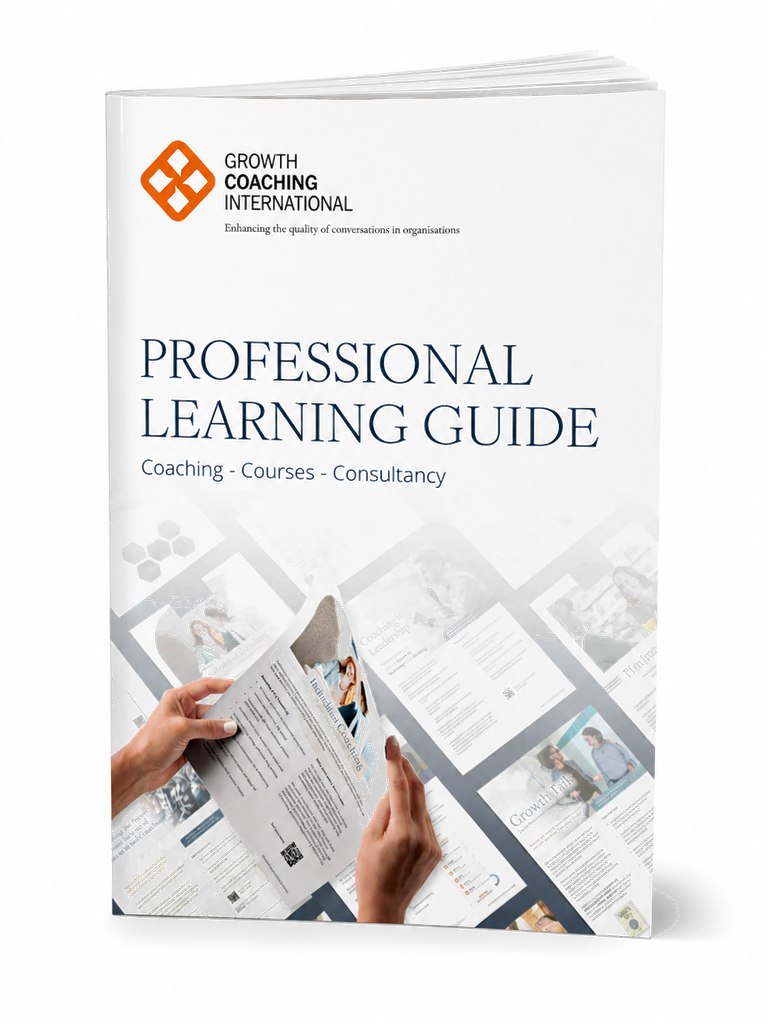
The whole catalogue
The GCI Professional Learning Guide
Every course we run, set out in one document: what each one covers, how long it takes, and who it is for. Useful whether you are choosing for yourself or building a case for a leadership team.
Browse the guideClose the guide
Loading the guide…
Stay in touch
Practical coaching ideas, in your inbox
Ideas you can use in your next conversation, plus research and resources from the team.